Inside the app
An income and expense tracker that knows Maltese tax
By Settlano · Last updated 9 October 2026
Books is Settlano’s income and expense tracker for Malta’s self-employed: it records your business income and expenses, not a household budget. Log income in seconds or photograph a receipt, and Books works out what each entry means for Maltese income tax, Class 2 and VAT, moving your set-aside the moment you log it.
Income tax and Class 2 are worked out on net profit, income less allowable expenses; equipment is not an expense at once, because capital allowances spread it over at least 4 years for computers and electronics and 10 years for other equipment, with a full year’s allowance in the year you buy it (S.L. 123.01; 2026 rates, verified 13 Jul 2026).
What is Books?
One tab holding your income, your expenses and your invoices, totalled by the month. Logging an income is a three-second act: amount, a tap, done. An expense can start as a photograph. And anything you invoiced never needs entering at all, because a sent invoice books its own income.
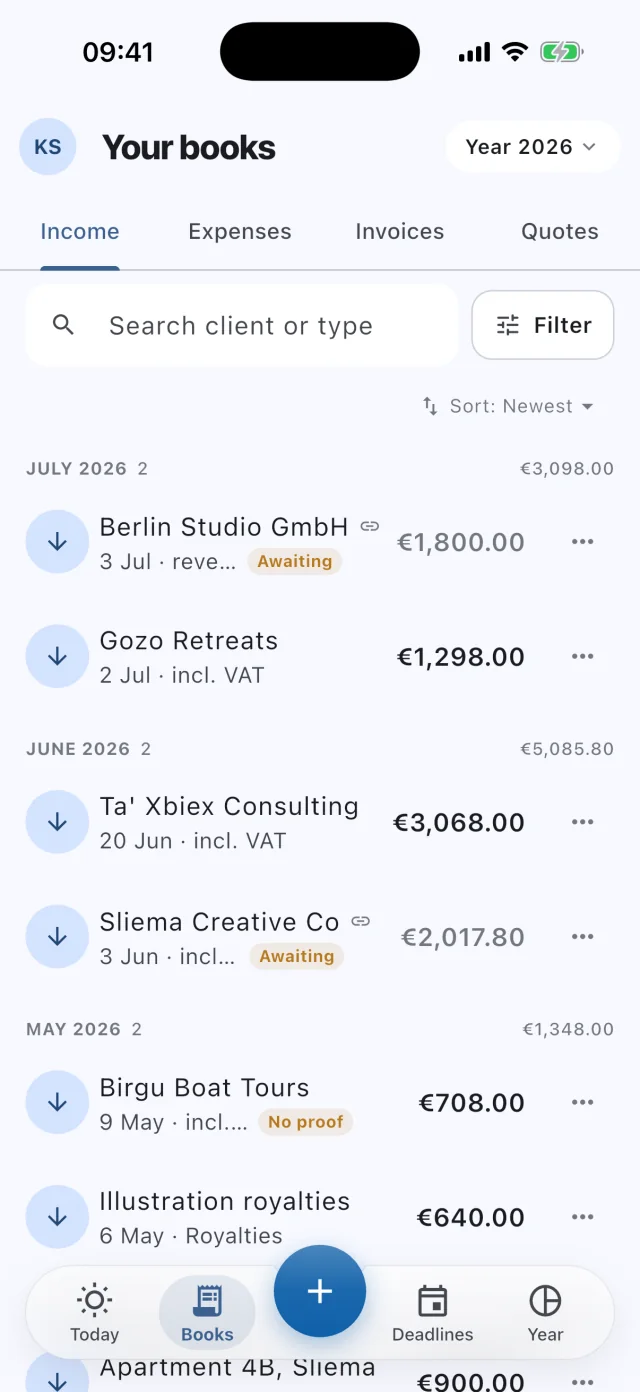
A missing receipt is flagged rather than forgotten, so the gap gets closed the week it happens instead of surfacing in an audit.
An entry carries its tax with it
The reason a tracker built for Malta beats a general one is what rides along with each record:
None of that is a report you run later. It is the state of the app after every entry, which is what makes the one number on the home screen, safe to spend, trustworthy.
Expenses, with the receipt behind each one
Photograph a receipt and the amount, supplier and date fill themselves in, on your device. Supplier VAT numbers and input VAT go into a register your accountant can use as it stands, with a trail from each figure to its receipt, rather than a shoebox with ambitions.
Keep the original too. Malta’s VAT Act asks for invoices to be kept in the original form in which they were sent or made available, whether paper or electronic (Cap. 406, Eleventh Schedule), so the photo of a paper receipt is a copy for your books, not a replacement for the paper.
A capital item, a laptop, a camera, is not pretended to be an ordinary expense: it is spread over its proper life as a capital allowance, computers over at least four years. What counts as an expense in the first place is in the allowable expenses guide.
Invoices that book their own income
Send an invoice from the app and the income is already in your books, VAT snapshotted, nothing to re-enter. A part payment updates the balance, a reminder is one tap away, and the day an invoice goes overdue, you know. Malta’s invoice requirements, the numbering rule included, are built in rather than left as your homework. More on invoicing in Settlano.
What does your accountant get?
A year of Books becomes an accountant pack in one tap: profit and loss, the income and expense registers with the audit trail attached, and a VAT summary, as one PDF with CSV beside it. You hand over a finished folder, and the conversation starts at the questions that need a human. Whether you still need an accountant has an honest answer: yes, and this is you arriving prepared.
Against a generic tracker or a spreadsheet
A generic income and expense tracker will hold your numbers and stop there. It has never heard of TA22, does not know that the VAT threshold counts by supply date rather than invoice date, and cannot tell an exempt supply from a reverse-charged one. A spreadsheet knows even less and, additionally, cannot watch the calendar. The tracking is table stakes; the Maltese tax attached to every entry is the product.
Common questions
Is Settlano an income and expense tracker?
Yes. Books, the app's middle tab, records every euro in and out: income logged in seconds, expenses with their receipts, and invoices alongside them, totalled by the month. The difference from a generic tracker is what happens next: each entry immediately moves your set-aside, because the tracker and the Maltese tax engine are the same app.
Does receipt scanning need an internet connection?
No. The scan runs on your phone, using the device's own text recognition, and fills in the amount, supplier and date. Nothing is uploaded. Your books stay on your device too; the few things that do leave the phone, such as the subscription check with Apple, are listed in the privacy policy.
Can it track my invoices too?
Yes, and better than tracking: a Settlano invoice books its own income the moment you send it, a part payment updates the balance, and you know the day an invoice goes overdue. Income you invoiced never needs entering twice.
Is this full bookkeeping software?
It is the books of a self-employed person: income, expenses, invoices, the VAT figures per return box, and an accountant pack. It is not double-entry company accounting for a limited company, and it does not pretend to be.
Can I export my books if I stop paying?
Yes. You can export your data as CSV files, PDFs, the accountant pack or an encrypted backup at any time, including after your subscription ends, without paying anything. Everything you entered stays readable.
The figures on this page
- €35,000 Article 11 line, counted by supply date across the calendar year · Cap. 406, the VAT Act
- Capital items: straight-line over the Schedule minima, computers over at least 4 years · S.L. 123.01
Every figure above is read from the same dated config the Settlano engine computes with: 2026 rates, verified 13 Jul 2026 · The charging acts: Cap. 123 · Cap. 406. The rules behind them were put to a commissioned accountant and legal review in August 2026, before launch.
Books is in the free iPhone beta today, receipts, invoices, set-aside and all.
Join the beta